ONE:On the 1st of June her Majesty arrived at St. Omer, intending to embark at Calais without delay for England. She wrote a letter to the Prime Minister, the Earl of Liverpool, commanding him to prepare a palace in London for her reception; another to Lord Melville, to send a yacht to carry her across the Channel to Dover; and a third to the Duke of York, repeating both demands, and complaining of the treatment she had received. Two days later Lord Hutchinson, with Mr. Brougham, who was her legal adviser, arrived with a proposition from the king, offering her fifty thousand pounds a year for life if she would remain on the Continent, and relinquish her claims as Queen of England. The queen instantly and indignantly rejected the offer, and started for England with all haste, having dismissed her foreign suite, including Bergami, her chamberlain, and the prime cause of the scandal that attached to her name. She would not even be dissuaded by Mr. Brougham, who most earnestly implored her to refrain from rushing into certain trouble and possible danger; or, at least, to delay taking the step until Lord Hutchinson should have received fresh instructions. She was peremptory, and sailed at once for Dover, accompanied by Lady Anne Hamilton and Alderman Wood, landing on the 6th of June. As this event was quite unexpected by Government, the commandant, having had no orders to the contrary, received her with a royal salute. The beach was covered with people, who welcomed her with shouts of enthusiasm. From Dover to London her journey was a continued ovation. In London the whole population seemed to turn out in a delirium of joy and triumph, which reached its climax as the procession passed Carlton House. No residence having been provided for her by the Government, she proceeded to the house of Alderman Wood in Audley Street.[See larger version]
ONE:Mr. Villiers renewed his motion on the 26th of May, 1840, after the presentation of petitions in support of his views bearing a quarter of a million of signatures. These signs of the growth of public opinion had no effect upon the House. There was a fixed determination to give neither Mr. Villiers nor the petitioners a fair hearing. He was assailed with a volley of every kind of uncouth sounds. The Speaker's calls to order were utterly disregarded, and it was not until, losing patience, he commanded the bar to be cleared, and members to take their seats, that the advocate of Free Trade could be heard by the reporters. It was useless to carry on the discussion amid this deafening clamour. Lord John Russell weakly demanded what the Government could do when a majority of the House was against any alteration in the law, and said he would vote for the motion, but not with a view to total repeal, as his own opinion was in favour of a moderate fixed duty. The House again divided, when 300 members voted for the landlords' monopoly, against only 177 in favour of inquiry.In March of this year Lord Cornwallis had brought a war in India with the implacable enemy of the British to a very successful close. Early in the preceding year, 1791, he had reinstated our ally, the Rajah of Travancore, in his dominions, and had further seized nearly all Tippoo's territories on the Malabar coast. He then determined to strike a decisive blow, by marching upon Tippoo's capital, Seringapatam. In February he took the city of Bangalore, and early in May he was on his route for Seringapatam. Tippoo was in the deepest consternation. Lord Cornwallis arrived in the neighbourhood of Seringapatam on the 13th of May, and immediately attacked Tippoo, who was drawn up with a large force. The Mysoreans broke and fled[395] before the British bayonets. The British army was in full view of the capital, and expected a rich booty, when Cornwallis was compelled to order a retreat. The forces of General Abercromby, who had to make his way from another quarter through the mountains, had not come up; neither had the Mahrattas, who were to join with twenty thousand men. The rains had set in, and the army was without provisions, for Tippoo had laid all the country waste. In these circumstances, Lord Cornwallis somewhat precipitately destroyed his battering guns, and retired from before Seringapatam. He sent word to Abercromby, who was now approaching, to retire also. On the 26th of May, the very first day of his retreat, the Mahrattas arrived; but as the rains continued and his soldiers were suffering from illness, he determined to retreat to Bangalore, where he procured four battering trains; and having laid in plentiful stores and obtained strong reinforcements, as soon as the season was favourable he again set out for Seringapatam. After taking different forts on his way, he appeared before that wealthy city on the 5th of February, 1792, in company with General Abercromby and a native force belonging to our ally, the Nizam. Tippoo was drawn up before the city, having between it and himself the rapid river Cauvery, and the place extremely well fortified and defended by batteries. He had forty thousand infantry and five thousand horse; but he was speedily defeated, and driven across the river into the city. There the British followed him, and, under the guidance of the brave generals, Medows and Abercromby, they soon penetrated so deeply into the place that Tippoo was compelled to capitulate. In these actions the British were said to have lost about six hundred men, Tippoo four thousand.
TWO:
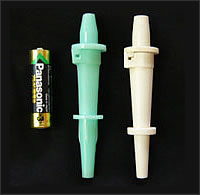
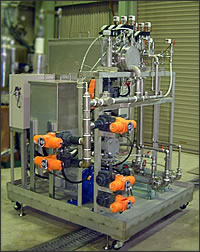
A hydrocyclone (liquid cyclone) injects treatment solution into stationary equipment to perform separation, classification, and concentration, and is an innovative separator with a very simple structure and no drive unit.
Structure of a hydrocyclone (liquid cyclone)
A suspension containing fine particles of several micrometers or more is supplied to a cylindrical container circumferentially at high speed. And as a result it starts to rotate and a centrifugal force is generated. At this time a gravitational acceleration of several tens of thousands of G is generated in the circumferential direction, and thus leading to fast sedimentation and concentration of the fine particles. The separated concentration can be freely selected by changing the supply rate (supply pressure and flow rate) and the flow ratio of the outlet. Our hydrocyclone (liquid cyclone) was designed and manufactured to classify and concentrate fine particles, and so has a small element.
THREE:PIUS IX. QUITTING THE VATICAN IN DISGUISE. (See p. 583.)A very instructive point of comparison is the relative increase of different classes of occupations in the decennial period from 1831 to 1841. A comparative return of the Commissioners includes males only, ages twenty years and upwards, and exhibits the following results. The number of occupiers and labourers in agriculture had decreased in that period from 1,251,751 to 1,215,264; but the Commissioners explained this result by supposing that numerous farm servants had been returned in 1841 as domestic servants instead of as agricultural labourers. Persons engaged in commerce, trade, and manufactures had increased from 1,572,292 to 2,039,409 (or 29?7 per cent.); capitalists, bankers, professional, and other educated men, from 216,263 to 286,175 (or 32?3 per cent.); labourers employed in labour not agricultural had decreased from 611,744 to 610,157; other males, twenty years of age, except servants, had increased from 237,337 to 392,211; male servants, twenty years of age and upwards, had increased from 79,737 to 164,384; including, however, as already noticed, many farm servants. For the purpose of instituting a just comparison of the relative increase of particular employments, it must be understood that the total number of male persons, twenty years of age and upwards (exclusive of army, navy, and merchant seamen), had increased in this period of ten years from 3,969,124 to 4,707,600 (or 18?6 per cent.). These[417] people were better fed than their ancestors, and had more work to do. There are three kinds of raw material the consumption of which is particularly indicative of social advancement, as giving employment to the people, adding to their comforts, and increasing the national wealth. These are timber, cotton, and wool. Taking all the different kinds of imported timber, there was an increase during the ten years of 37 per cent.; in cotton there was an increase of 61 per cent.; and of sheep and lamb's wool, in addition to the home production, there was an increased importation of more than 78 per cent.
Equipment costs can be reduced.
Operating costs can be reduced.
Maintenance costs can be reduced.
Any change in raw material and product can be easily addressed.
Large amounts can be treated in a small area.
Separation and cleaning are easy because of the simple structure.
Simplified control
This equipment can be operated in synchronization with external devices.
Alarm and interlock mechanism.
THREE:On the 19th of October the French attacked the duke with sixty thousand men, and though his little army fought with its usual dogged bravery it was compelled to give way. It did this, however, only to assume a fresh position, still covering Nimeguen, where, on the 27th, the French again attacked it, and compelled it to retire from the contest. The duke led the wreck of his army across the Waal and the Rhine, and posted himself at Arnhem in Guelderland, to throw some impediment in the path of Pichegru, who was advancing, at the command of the Convention, to reduce Holland. Nimeguen, full of Dutch traitors, soon opened its gates; Maestricht did the same to Kleber; and at the end of the campaign the gloomiest prospects hung over Holland.Thus argued the Conservatives, and not without effect, for the clause against disfranchising the freemen was carried only by a majority of twenty-eight; and in the passage through the Lords several important amendments were carried against the Government, owing chiefly to the vigorous opposition of Lord Lyndhurst. He proceeded to convert the Bill into what was called a Conservative arrangement, and when Peel's moderation was brought up against him, is said to have remarked, "Peel! What is Peel to me? D¡ª¡ª Peel!" On an amendment which he proposed¡ªto omit the clause disfranchising the freemen¡ªhe defeated the Government by a majority of 93; the numbers being 130 to 37. He followed up this victory by a motion to secure to the freemen their Parliamentary franchise, which was carried without a division. The Commons thought it better to adopt some of these alterations, however repugnant to their feelings, rather than lose the measure. The Bill, as amended, was accordingly passed on the 7th of September. London, with its numerous and wealthy incorporated guilds, was reserved for future legislation, which the lavish hospitalities of the Mansion House and Guildhall[390] postponed to a later date than municipal reformers then thought of.
Classification and concentration for the manufacture of inorganic powder materials
Classification of ceramic materials
Removal of fine particles, including iron powder
Removal of fine particles from pigments
Removal of fine organic particles from solvents
Separation of starch and yeast
Removal of fine particles from high-temperature strong acid solutions
Removal of fine particles from low-temperature solutions